Key takeaways
- Soft skills are the ways you work with people and with problems: communicating, cooperating, organising yourself, adapting, leading and solving things.
- On a CV, a soft skill named without proof adds nothing: recruiters read the same adjectives on almost every CV and have no way of checking them.
- What works is writing an achievement in which the skill shows on its own: the situation, what you did and what changed, with a figure or a scope.
- Pick three or four skills the job advert asks for, prove each one in your experience and name them in your profile or skills list only once they are backed up.
- Hard skills, such as software, a language or a standard, do belong in a list under their exact name, but they become credible with a level and an achievement where you used them.
What soft skills are and why a list doesn't convince
Soft skills, also called interpersonal or transferable skills, are about how you work: how you communicate, how you cooperate, how you organise yourself, how you react when things change and how you solve problems. They differ from technical skills, such as using a piece of software, speaking a language or knowing an accounting standard, because they don't belong to one job: you take them with you from one role to the next.
The trouble is that everyone lists them. «Proactive, reliable, excellent team player» appears on so many CVs that recruiters no longer read it as information. It could hardly be otherwise: nobody writes «I struggle to work with others». A soft skill written as an adjective can't be checked, so it doesn't set anyone apart. What does set you apart is a fact that shows it.
Being hard to prove doesn't mean they count for little. In employer surveys these skills rank among the most sought after, both in studies about the future of work and in those asking what recruiters look for on a CV.
employers surveyed by the World Economic Forum consider analytical thinking a core skill. It is followed by resilience, flexibility and agility, and by leadership and social influence.
Source: World Economic Forum, The Future of Jobs Report 2025, chapter 3: Skills outlookof workers' core skills are expected to change by 2030, according to the employers surveyed for the Future of Jobs Report 2025.
Source: World Economic Forum, The Future of Jobs Report 2025, chapter 3: Skills outlookUS employers surveyed by NACE look for evidence of problem-solving on a new graduate's CV; around 8 in 10 look for teamwork (Job Outlook 2025, 237 employers).
Source: NACE, What Are Employers Looking for When Reviewing College Students' Resumes? (Job Outlook 2025, US, 237 employers)How to put soft skills on a CV: show rather than name
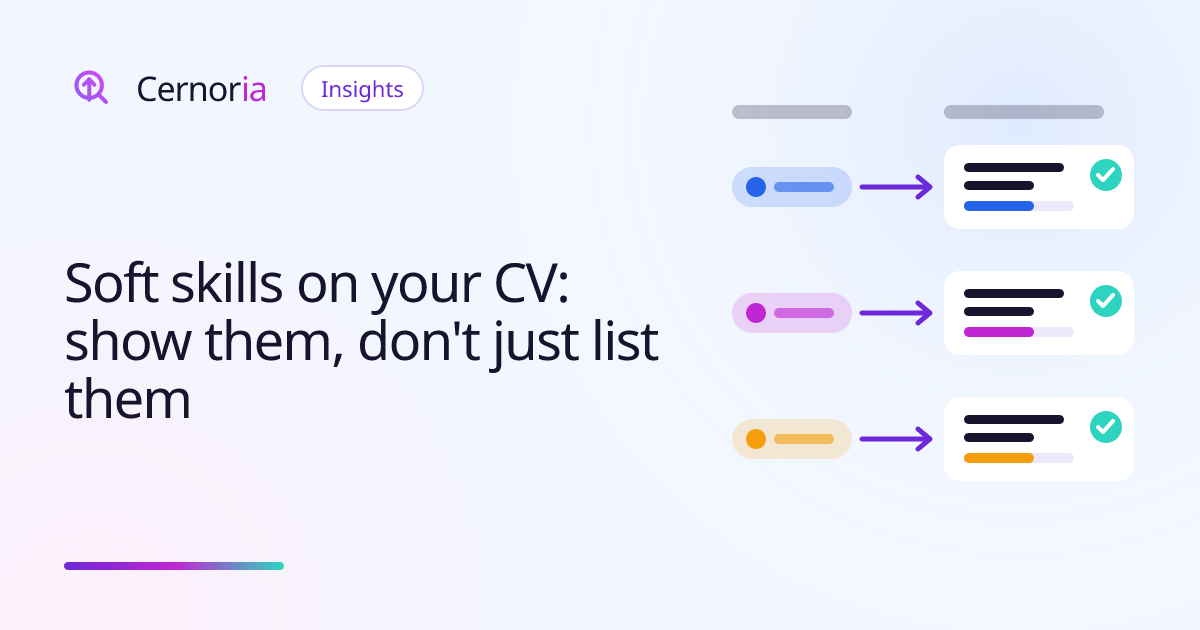
The rule is simple: you don't declare the skill, you let it show. Instead of writing «strong communication skills», you write what you achieved because you communicated well. The reader draws the conclusion themselves, and a conclusion of their own is far more convincing than an adjective handed to them.
Recruiters decide in seconds whether to keep reading: in the Ladders eye-tracking study of 2018, carried out in the US, the first screen of a CV lasted 7.4 seconds on average. That is why the proof isn't hidden at the bottom but sits in the lines under each job, which is where people look first.
- Choose three or four skills from the advert
Read the job advert and mark the soft skills it asks for, even when they are phrased indirectly: «customer-facing» means communication, «fast-paced environment» means adaptability. Don't try to prove ten: three or four, well backed up, are enough.
- Find the situation that shows it
For each one, think of a specific moment at work, at university or in volunteering when that skill made the difference: a conflict you resolved, a team you coordinated, a change you adapted to.
- Write it as an achievement
Past-tense verb, what you did and what changed as a result, with a figure or a scope. The skill doesn't have to be named: it has to be visible.
- Name it only once it's proved
In your profile or skills list you can use the advert's exact wording, as long as there is a line further down that backs it up. Without proof, the word stays out.
The table: from skill to evidence
This is the table we use at Cernoria to get from an adjective to a line you can defend. The middle column matters most: what kind of fact proves each skill. The examples are made up; swap them for your own.
| Skill | What proves it | How to write it | What to avoid |
|---|---|---|---|
| Communication | Something you explained that others understood or used | «Wrote the user guide for the new system for 60 staff across three branches» | «Excellent written and verbal communication» |
| Teamwork | A result that came from a group and your part in it | «Coordinated with logistics and sales to launch two products with no delays» | «Excellent team player» |
| Leadership | People you guided or trained, or whose work changed | «Trained the year's four new starters; all four are still on the team» | «Natural leader» |
| Problem-solving | A specific problem and how things stood afterwards | «Found why orders were being duplicated and set up the check that prevents it» | «Solutions-oriented» |
| Adaptability | A big change and how you kept delivering | «Moved to remote working with the whole team without lowering service volume» | «Flexible and adaptable» |
| Organisation | Deadlines, volume or tasks you handled in parallel | «Ran 12 client accounts in parallel with weekly deliverables» | «Highly organised» |
| Negotiation | An agreement you reached and on what terms | «Renegotiated deadlines with three suppliers and avoided a break in service» | «Strong negotiation skills» |
| Initiative | Something you started without being asked | «Proposed and built the team's first tracking dashboard» | «Proactive self-starter» |
Hard skills on a CV: examples by field
Hard skills, also called technical skills, are knowledge you learn and can prove: a piece of software, a programming language, a foreign language, a standard or a machine. Unlike soft skills, these are worth naming in a list, because the job advert and applicant tracking systems look for them by their exact name.
What makes them believable is context. Write the tool the way the advert writes it («Excel», not «spreadsheets»; «Sage», not «accounting software»), give it a level you could defend in a technical test and tie it to an achievement in your experience. If you haven't used it in a job yet, it can go with the course or project where you learned it.
| Field | What adverts often ask for | How to show it on your CV |
|---|---|---|
| Finance and administration | Advanced Excel (pivot tables, formulas), Sage, Xero or SAP, bank reconciliations | «Automated the monthly reconciliation in Excel, cutting it from three days to one» |
| Sales and customer service | A CRM such as Salesforce or HubSpot, account management, invoicing | «Organised a 200-client book in HubSpot and set up renewal reminders» |
| Marketing and communications | Google Analytics, Google Ads or Meta campaigns, SEO, design tools | «Ran the brand's Google Ads campaigns and tracked results in Analytics» |
| Technology and data | Languages such as Python, JavaScript or SQL, Git, cloud services | «Wrote the weekly sales reports in SQL that used to be built by hand» |
| Logistics and operations | A warehouse management system (WMS), stock control, a driving or forklift licence | «Ran rolling stock counts in the WMS for two years» |
| Languages (any field) | The language with its CEFR level (A1 to C2) or a certificate | «Spanish C1: handled Spanish-speaking clients in Latin America» |
Where each skill goes on your CV
Soft skills don't live in one place. The proof sits in your experience; the name, if you use it, goes in your profile or skills list, always backed up by what comes below.
| Part of the CV | What goes there | Example |
|---|---|---|
| Personal statement | One or two skills, tied to your specialism | «Purchasing analyst with experience negotiating with suppliers» |
| Work experience | The achievements that prove each skill | «Renegotiated terms with the 12 main suppliers» |
| Skills | The advert's wording, if it is already proved above | Negotiation, planning, customer service |
| Education, volunteering or projects | The proof when you have little work experience | «Organised the university careers fair with 30 employers» |
Where to find the evidence if you don't have it to hand
Many people think they have no proof of their soft skills because they never measured them. It is nearly always there, just in another form: appraisals, thank-you emails, jobs you were given because of how you worked, problems passed to you because people knew you would sort them out.
EURES, the European job mobility portal, suggests two routes that work. One is to look beyond paid work: university projects, volunteering, sport or groups you took part in; if you organised an event, that is project management. The other is to ask former colleagues or managers what they saw as your most valuable contribution or quality. The answer usually brings the situation you were looking for.
The skills most in demand and how to spot them in an advert
In NACE's Job Outlook 2025 survey of US employers hiring new graduates, the signals most sought on a CV were problem-solving and teamwork, followed by written communication, initiative and a strong work ethic. In the World Economic Forum report, employers put analytical thinking, resilience and flexibility, and leadership at the top. These are surveys from other markets, but the list looks very much like what adverts on Indeed, Reed or LinkedIn ask for in the UK.
An advert rarely says «soft skills». It names them sideways: «customer-facing», «fast-paced environment», «working across teams», «self-motivated». Translating those phrases into specific skills is the first step to knowing what you need to prove.
Cernoria's rule: no skill without its proof
A soft skill you can't back with an example falls apart at the first interview question: «Tell me about a time when you had to…». That is why we work to one rule: every skill on the CV has a fact behind it that you could talk about for two minutes, with the situation, what you did and what happened next. If you don't have one, the skill doesn't go in, even if you have it.
At Cernoria we see it this way: soft skills aren't written, they're shown. If whoever reads your CV can reach the conclusion on their own, they will believe it far more than if you hand it to them.
A worked example: the same CV, before and after
A made-up case to see the method in action. Hannah Example is a customer service adviser at Pennine Services in Leeds and is applying for a customer service team leader role. The advert asks for customer communication, working across teams, organisation and training new starters.
Before, under skills: «Effective communication, team player, organised, leadership, proactive, empathetic».
After, first line under the job (communication): «Handled around 40 enquiries a day by phone and live chat and kept a satisfaction score of 4.6 out of 5 throughout 2025».
Second line (working across teams): «Set up a process with the billing team for payment complaints, cutting resolution time from seven days to three».
Third line (training): «Trained the five people who joined the team over the past year using a response guide I wrote».
After, under skills: «Customer service, cross-team coordination, training». «Proactive», «empathetic» and «leadership» came out, because nothing in this job proved them.
The check before you send it
Before you apply, go through every soft skill on your CV with these questions. If any answer is «no», that skill gets proved or goes.
- Does every skill in your profile or list have a line of experience that backs it up?
- Are the skills you chose the ones the advert asks for, in its own words?
- Does each achievement have a situation, what you did and a result or scope?
- Have you removed the stand-alone adjectives («proactive», «reliable», «dynamic»)?
- Could you talk about each example for two minutes in an interview?
- Are there three or four well-proved skills rather than ten unproved ones?
Frequently asked questions
Which soft skills should I put on a CV?
The three or four the advert asks for that you can prove with a fact from your experience. The most requested are usually problem-solving, teamwork, communication, organisation and adaptability, but the advert you are applying to is what decides.
Should soft skills go in a separate section of the CV?
They can go in the skills section, but only if your experience proves them. The proof always sits in the lines under each job; the list is there so the advert's exact words appear on your CV.
What skills should I put on a CV with no experience?
The ones the advert asks for that you can prove through your studies, placements, volunteering or projects. Coordinating a group project proves teamwork and organising an event proves organisation; for hard skills, list the software and languages you learned alongside the course or project where you used them.
How many soft skills should a CV include?
Between three and five, well chosen and well proved. A list of ten unsupported adjectives costs you credibility, because the reader can check none of them and reads it as filler.
What is the difference between soft skills and hard skills?
Hard skills are knowledge you can measure or certify, such as software, a language or a standard. Soft skills are ways of working with people and with problems, and you prove them with specific situations, not qualifications.
Sources
- World Economic Forum, The Future of Jobs Report 2025, chapter 3: Skills outlook
- NACE, What Are Employers Looking for When Reviewing College Students' Resumes? (Job Outlook 2025, US, 237 employers)
- EURES (European Commission), Struggling to list your skills on a CV? You have more than you think, 2026
- Ladders, Eye-Tracking Study, 2018
 What an ATS actually does and how to get past it (2026)
 How to write a cover letter, and when it changes the outcome (2026)
 How to tailor your CV to each job ad without making anything up