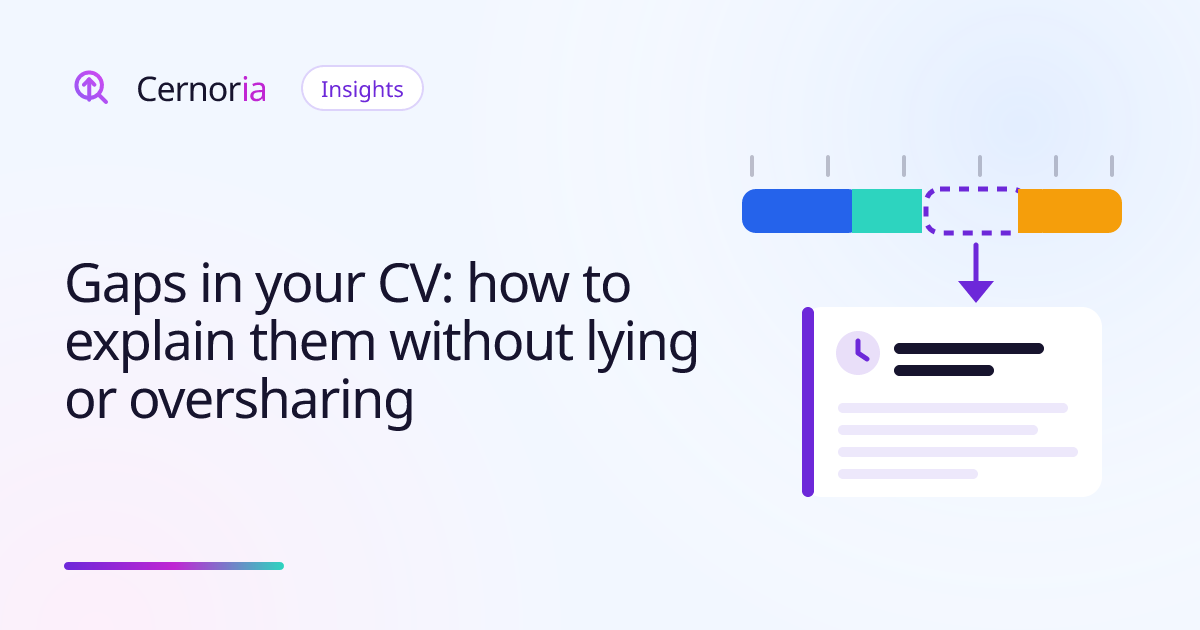
Key takeaways
- A gap in your CV is any period out of work between two jobs, or since your last job. Gaps are common and, explained well, rarely rule anyone out.
- Gaps of under three months need no explanation; gaps of more than six months are best named on a line of their own, with month and year dates.
- The explanation depends on the reason: caring, study, redundancy, health or a long search are told differently, but never with anything made up.
- At interview, three sentences are enough: what happened, what you did during that time and why you are ready for this role now.
What a gap in your CV is, and why it matters less than you think
A gap in your CV is any period without paid work that shows up when someone reads your dates: the months between one job and the next, or the time since your last role. It usually worries the candidate far more than the person reading. What raises questions is not the gap itself but a gap with no explanation, because it leaves the reader to imagine the worst.
The most common reasons are also the most ordinary: looking after a child or a relative, studying, redundancy, illness, a move or a search that took longer than planned. The International Labour Organization estimates that 748 million people worldwide are outside the labour force because of caring responsibilities; in Europe and Central Asia, 21% of women outside the labour force give that as the main reason. A career break is not an oddity to be hidden.
people aged 15 and over were outside the labour force because of caring responsibilities in 2023, according to the ILO. Of them, 708 million were women.
Source: International Labour Organization (ILO), Unpaid care work prevents 708 million women from participating in the labour market, 29 October 2024of women in Europe and Central Asia who are outside the labour force cite caring as the main reason, according to the same ILO estimate.
Source: International Labour Organization (ILO), Unpaid care work prevents 708 million women from participating in the labour market, 29 October 2024of the almost 23,000 people LinkedIn surveyed worldwide in January 2022 said they had taken at least one career break.
Source: LinkedIn, global survey on career breaks (22,995 people, January 2022), reported by Allwork.Space, April 2022When a gap needs explaining and when it doesn't
Not every period out of work deserves a line on your CV. A month between two jobs is a normal part of any move and nobody will ask about it. The longer the gap, the more context it is worth giving, because whoever reads your CV does the maths on your dates in seconds.
The National Careers Service puts it simply: having a gap in your CV is not a problem, but you might be asked about it, so say why you took the time off and focus on what you did during it. The table below is the rule of thumb we use at Cernoria to decide how much to say, depending on the length of the gap.
| Length | On your CV | At interview |
|---|---|---|
| Under 3 months | Nothing. Month and year dates are enough | Only if asked, in one sentence |
| 3 to 6 months | Optional: one line if you did something concrete (a course, a project) | Have it ready: the reason and what you did |
| 6 months to 2 years | A line of its own with dates and the reason in a few words | The three sentences: what happened, what you did, why now |
| More than 2 years | A line of its own and, if you can, what kept your skills current | The same, plus how you caught up with your field |
| Several short gaps | Group short contracts, temping or agency work under one heading | Explain the pattern once, not every gap |
How to show gaps in your CV without hiding them
The most common temptation is to cover the gap: years only instead of months, a stretched leaving date or a job that never existed. All three are easy to spot, through a reference, your P45 or a simple question at interview, and they turn a harmless gap into a doubt about your honesty. What works is naming it.
- Use month and year dates throughout
That way the gap looks the size it is. Years for one job and months for another draw more attention than the gap itself.
- Give it a line of its own in date order
Put it where it happened, with the dates and the reason in a few words: «Career break for family care», «Training in data analysis», «Job search and freelance projects».
- Add what you did, if it helps the application
A course, volunteering, freelance work or a project of your own go under that line, in the same format as a job: what you did and what came of it.
Reason by reason: what to put on your CV and what to say at interview
Each reason is told differently. What they share is that the explanation is short, does not apologise and ends by looking forward: what you bring to the role and why you are available now. This table is the starting point we use at Cernoria for each case.
| Reason | How to show it on your CV | What to say at interview | What to avoid |
|---|---|---|---|
| Caring for a child or relative | «Career break for family care», with dates | That it was a choice, that the situation has ended or is arranged, and that you are now fully available | Details of your relative's health or your private life |
| Study or training | As any other qualification, with institution, course and dates | What you learnt and how it applies to the role | Presenting it as something to «fill the time» |
| Redundancy or dismissal | Nothing special: the job ends on its real date | One sentence on the business decision, without blame, and what you did next | Criticising your previous employer |
| Health | «Career break for personal reasons» or «for health reasons», with no diagnosis | That you are ready to work; medical detail is not needed | Sharing more than you are comfortable with |
| A long job search | What you did meanwhile: courses, freelance work, volunteering | What kind of role you were looking for and why this one fits | Saying «I couldn't find anything» and stopping there |
| Travel, a move or your own project | A line with the project or the move and what you learnt | What that stage gave you and why you want to return to employment now | Sounding as if you will leave again soon |
Redundancy or dismissal: how to explain it without blaming anyone
Losing a job is the gap people dread most, and the one best settled in a sentence. If it was a redundancy, a closure or a restructure, say so: it was a business decision, not a judgement on you. «The company closed its Leeds office in March and my role was made redundant» needs no follow-up. The National Careers Service advises talking about a dismissal at the interview rather than at the application stage and, for redundancy, describing the business decision rather than yourself.
If the dismissal was about your performance, an honest answer has three parts: what happened in one sentence, what you learnt and what you do differently now. Nobody expects a spotless record; they want to see that you understand what went wrong. What does rule you out is blaming your old manager or colleagues, because the interviewer pictures being next.
Health and personal matters: how much to say
A gap because of health, yours or someone close to you, can be explained without any medical detail. «I took time out for health reasons that are now resolved» is a complete answer. What the employer needs to know is whether you can do the job today, not what happened. The National Careers Service says the same for physical and mental health: you only need to share what you are comfortable with.
The same goes for other personal matters, such as a separation, a bereavement or a family situation. You can call them «personal reasons» and move straight on to what matters for the role. If someone presses, calmly repeating that it was a personal period that is now behind you is usually enough.
At Cernoria we see it this way: you don't explain a gap to justify yourself, you explain it so that the reader doesn't have to guess. One honest line on your CV and three calm sentences at interview settle it better than any stretched date.
How to explain a gap at interview in 30 seconds
The short answer works best. If you go on, it sounds as if the subject makes you uneasy or there is more to it. Prepare it beforehand, say it out loud a couple of times and always finish on something about the role, so the conversation carries on from there.
- What happened, in one sentence
«Between March 2024 and June 2025 I was caring for my father.» No hedging and no apology.
- What you did during that time
«Alongside that I finished an advanced Excel course and kept the books for a small family business.» If you did nothing work-related, say so anyway and move to the third step.
- Why now and why this role
«That situation is now arranged and I am fully available. I'm interested in this role because it uses exactly what I did before: cost control and monthly reporting.»
A worked example: Laura's gap
An invented case to show the method in practice. Laura Example worked for six years as an accounts assistant at Northfield Supplies until February 2024. She spent 16 months out of work caring for her mother and in June 2025 started applying for assistant accountant roles. Her first CV showed years only, and at interview she stumbled when she reached that part.
Before, on her CV: «Northfield Supplies, accounts assistant, 2018 to 2024». The leaving date half hid the gap and the first question at every interview was what she had done since.
After, on her CV: «Northfield Supplies, accounts assistant, March 2018 to February 2024», followed by a line of its own: «Career break for family care, March 2024 to June 2025. Advanced Excel and Power BI course (40 hours), 2025».
After, at interview: «In 2024 I stopped working to care for my mother. During that time I took a Power BI course and kept the books for a small family shop. That situation is now resolved and I am fully available. I'm interested in this role because month-end close and reporting are what I did most at Northfield».
What changed: the gap stopped being a surprise. The reader knows the reason before the interview, and the conversation moves straight on to her accounting experience.
What not to do with a gap in your CV
Before you send your CV, check that none of these shortcuts has crept in. They all seem protective and they all end up weighing more than the gap.
- Stretching the leaving date of a job so the gap disappears.
- Inventing a job, an employer or freelance work that never existed.
- Using dates that don't match your P45 or your references.
- Apologising for the gap, on your CV or at interview.
- Giving medical or family detail nobody asked for.
- Leaving a gap of more than six months unexplained.
Frequently asked questions
How do I explain gaps in my CV at an interview?
With three short sentences: what happened, what you did during that time and why you are ready for this role now. Prepare it in advance, don't apologise and finish by talking about the job, so the conversation moves on from there.
How long out of work counts as a gap in a CV?
In practice, from about three months someone may ask about it, and from six months it is worth naming on a line of its own. A month or two between jobs is normal and needs no explanation.
Can I use years only on my CV to hide a gap?
It's not a good idea. Years for one job and months for another draw more attention than the gap, and the real dates appear on your P45 and in references. Use month and year throughout and explain the gap in one line.
Do I have to say on my CV that I was made redundant?
There is no need to write it on your CV: the job ends on its real date and the reason comes up at interview if you are asked. If it was redundancy, say so plainly; if it was about performance, say what you learnt and what you do differently.
What do I put on my CV if I was caring for a relative?
A line of its own with the dates, such as «Career break for family care», in the place where it happened in your timeline. If you took a course or did occasional work in that time, add it underneath. You don't need to give details of anyone's health.
Sources
- International Labour Organization (ILO), Unpaid care work prevents 708 million women from participating in the labour market, 29 October 2024
- LinkedIn, global survey on career breaks (22,995 people, January 2022), reported by Allwork.Space, April 2022
- National Careers Service, Explain gaps in work history
 What an ATS actually does and how to get past it (2026)
 How to write a cover letter, and when it changes the outcome (2026)
 How to tailor your CV to each job ad without making anything up